
Application · On-site PMI
On-site positive material identification.
Positive Material Identification (PMI) is among the applications described in JIEBO’s instrument information. We discuss the object and its location together with the material, the target measurements and the instrument configuration.
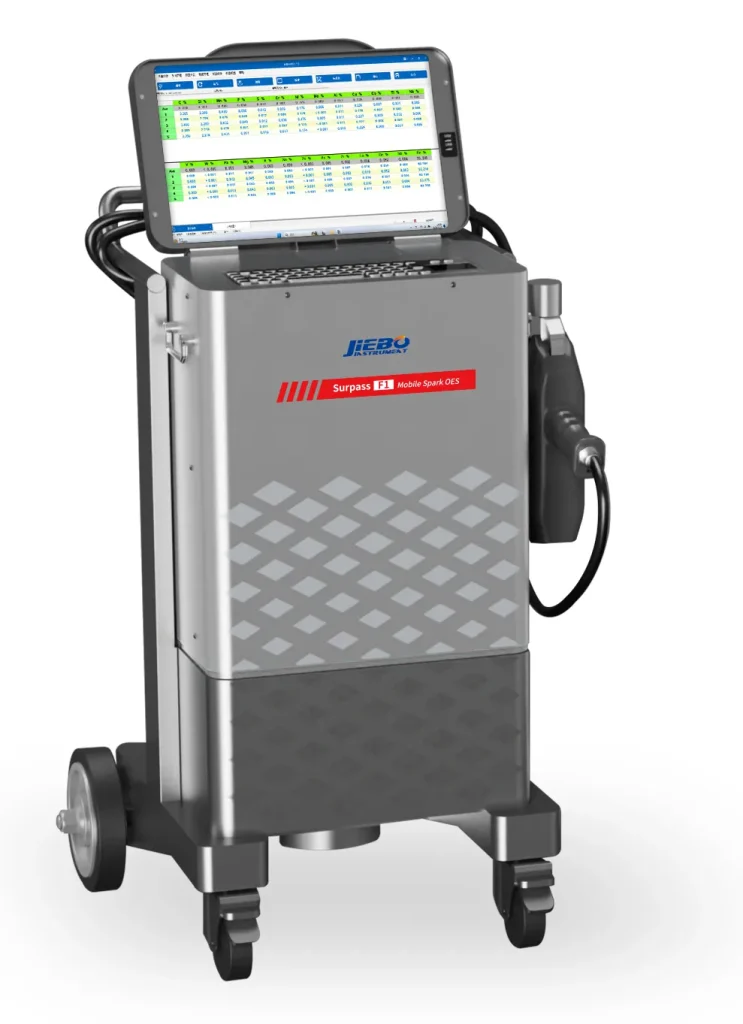
The Surpass F1 mobile spectrometer is built to bring the analysis to the sample.
The brief
Describe the real object, not only the industry.
Tell us what needs to be checked, where it is and why a site-based approach fits. Say whether the object can be moved, whether a sample can be taken and which parts can be reached.
- Material and purposeKnown material information and what the identification or measurement must establish.
- MeasurementsTarget elements, relevant ranges and any written technical requirement.
- Object and accessShape, dimensions, condition and the area that can be reached for testing.
- PreparationWhether sampling or surface preparation is possible and what is restricted.
- LocationWhere the work takes place and the practical conditions there.
- Operator and supportWho performs the work and what training or assistance is needed.

The instrument
Surpass F1 for testing at the sample.
The Surpass F1 is a mobile optical emission spectrometer for on-site testing of metal material, including large components that are not easily cut.
- ApplicationsQuality control, positive material identification, scrap metal sorting and recycling.
- IndustriesAerospace, petrochemical, foundry and metal fabrication.
- Also described forAnalysis of impurity elements in scrap metal and incoming inspection.
From object to result
A usual path for an on-site check.
- 01Identify the object
The part, its material record and the question to answer.
- 02Reach the test area
Choose the surface on the object that can be accessed.
- 03Prepare the surface
Clean the measurement point as the instrument requires.
- 04Measure and review
Read the result against the requirement for the object.
Evaluation and support
Plan the evaluation, and the support behind it.
A relevant evaluation addresses your material and measurement requirement under conditions that matter for the task: the object, the configuration, the preparation and the result that will be reviewed.
We also discuss installation or setup, operator training and the support arrangement for the proposed instrument, through JIEBO or a local distributor.
Application records
Related application records.
Example records for this kind of task.

Application record
Incoming Aluminium Alloy Checks for a Component Supplier
An automotive component supplier sets up composition checks for incoming aluminium alloy bar before machining.
Application record
Planning PMI for an Industrial Maintenance Team
An industrial maintenance team defines access, item identities and exception handling for a site inspection.
Application record
Composition Checks for a Foundry in Southeast Asia
A foundry organises sample preparation, measurement records and review before a melt decision.
Knowledge
Articles to read next.
Choosing a Spark Optical Emission Spectrometer for Ferrous and Non-ferrous Alloys: A Practical Checklist Before You Compare Instruments
Start with the material, reporting task and sample conditions before comparing an instrument configuration.
Planning On-site PMI with a Mobile Optical Emission Spectrometer
Prepare the work area, sample access and reporting rules before moving a measurement task to site.
A Practical Workflow for Composition Checks at a Foundry
Build a traceable sequence from sample identification to the decision made from the result.
Start with the object you need to check.
Tell us the material, target measurements, location and access. A short, accurate task description is the best starting point.